- Products
- Service
- Expertise
- Learning Center
- fischer group
- Press Releases
- References

- Home
- References
- Space for medical innovation - with secure installation

For modern high-performance medicine, patient care, as well as research and teaching according to the latest standards, the ideal spatial environment and structural infrastructure are currently being created at the University Hospital Tübingen. Founded in 1805, the University Hospital is largely spread over two sites: the clinic locations "Tal," north of the city center, and "Berg," northwest of the center on the mid-elevation of Schnarrenberg.
The Crona Clinics went into operation in 1988 and 1989. Their name is derived from the abbreviations of the facilities included at the time of occupancy: the clinics for Surgery, Radiology, Orthopaedics, Neurology, and Anaesthesiology. Today, additional disciplines are also housed in the building. The central operating theatre is located in the basement. Even today, the Crona Clinics form the focal point of the site on Schnarrenberg. To spatially advance this important facility for healthcare as well as research and teaching in Germany into the future, numerous conversions, expansions, and renovation measures are currently underway.
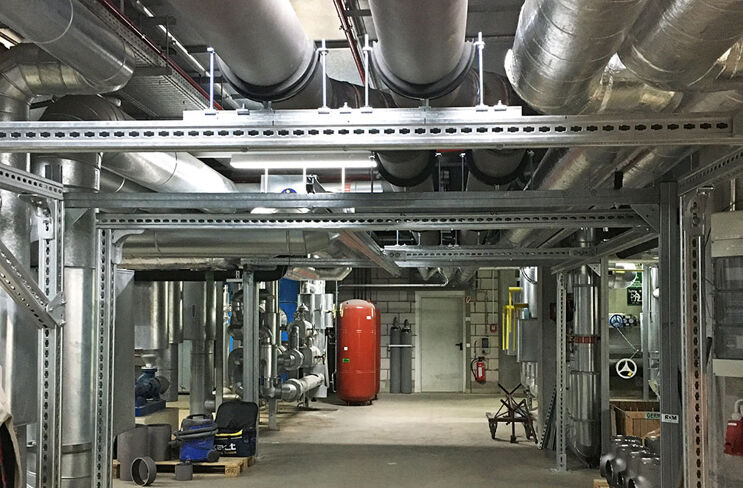
Such heavy installations for Technical Building Equipment (TGA) can be implemented particularly flexibly and efficiently with the fischer robust rail system FMS. This eliminates the need for fastening with an elaborate steel construction, which requires its own planning and prefabrication and often leads to construction tolerances on site. In contrast, the FMS rail system allows for shorter construction and assembly times as well as lower costs in pipe installations like those in Tübingen.
First, the existing situation of installations and devices at the Crona Clinics was recorded to accurately determine the dimensions and anchor points of the frame construction. Subsequently, the Dlubal structural analysis software RSTAB was used. With this program, the steel frame construction could be graphically captured and calculated based on the product data stored for the fischer installation system FMS and the parameters recorded on site. This allowed both the structurally required dimensions and the correct stiffenings and shaped parts to be optimally planned – including comprehensive documentation of the calculations, corresponding dimension sketches, and the material list as a basis for the customer’s order. With these services, fischer successfully supported the executing company in safely installing the cooling routes with an innovative and user-friendly solution, instead of having to plan and install an elaborate steel construction and pipe supports.
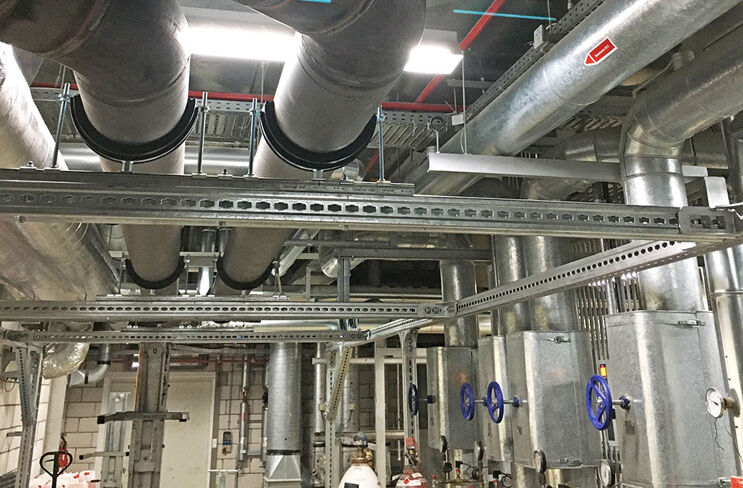
The fischer massive rail system FMS ensured rapid construction progress without prefabrication directly on site during the pipe installation at the Crona Clinics. The universal connectors, together with the profiles and massive construction elements, enabled versatile use as well as easy adjustment during the installation and alignment of the pipe routes. Existing structures could be easily expanded and adapted. For processing, it was sufficient to cut the profiles at right angles. This helped to avoid waste. The factory-prefabricated construction elements did not need to be further welded or processed on site. The fully hot-dip galvanized product range could be installed without subsequent coating. All of this led to quick and easy assembly with low time and cost expenditure.
Specifically, FMS items such as FMP mounting profiles in 3 and 6 m lengths were used. The FMHB hammerhead plug connectors connected the mounting profiles to each other and to the substrate. This included FMSF saddle flanges, FMA mounting brackets, FMUF clamp connections, and FMVB joint connectors in matching sizes and designs. All these items used in the project are only part of the extensive and flexible FMS range.
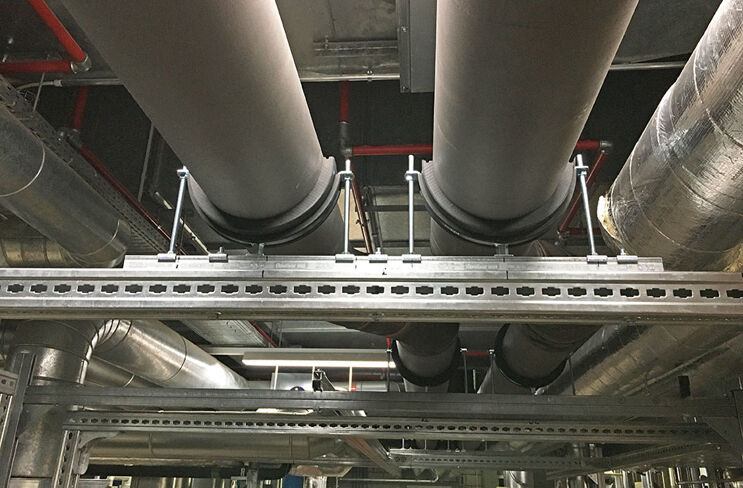
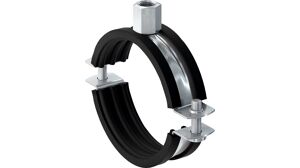
For fastening the cold pipe route to the mounting profiles, cold pipe clamps FRS-K with the respective accessories were installed. FMEC end caps were added to close off the profile ends. All system components could be easily and quickly assembled into the desired construction using the modular system principle.
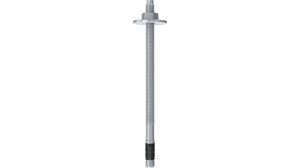
In addition to the FMS items, further product solutions from the fischer installation systems program were used in the project, such as the fischer universal rail system FUS, FRSM solid pipe clamps, and accessories. From the fischer anchor range, the FAZ II 12/20 GS bolt anchor was supplied for fastening the frame construction.
Thus, fischer successfully supported its client overall from planning and calculation through delivery and on-site project support to the successful completion of the construction project.