- Products
- Service
- Expertise
- Learning Center
- fischer group
- Press Releases
- References
- Home
- References
- La Grande Arche – Facade construction par excellence

Heat, frost, moisture, and air pollution – the ravages of time take their toll on the proudest buildings.
“At the La Grande Arche office skyscraper in Paris, the high wind loads and rain also caused visible signs of wear and dirt on the facade,” says Steven-Henrik Maier, Market Manager France at the fastening specialist fischer SystemTec.
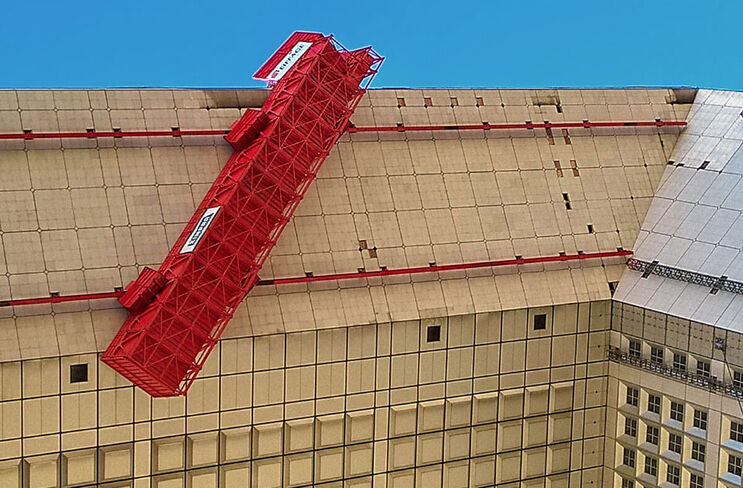
“Deformations, chipping, and cracks appeared on the facade made of white Carrara marble. As a result, in 2015 the responsible parties finally decided to renovate the facade, after already considering it back in 2009.”
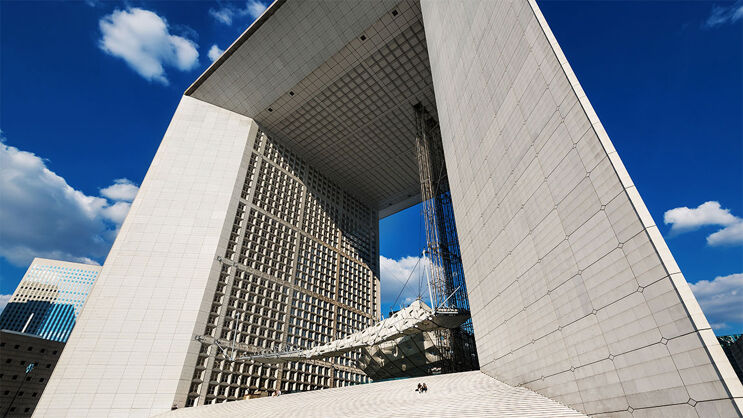
Since its completion in 1989, the „Grande Arche“ has been one of the most popular viewpoints in Paris. No wonder, as the building is located at the end of the approximately eight-kilometre sightline that stretches from the Louvre art museum over the Champs-Élysées and the Arc de Triomphe to the office skyscraper.
The monumental structure was designed by the Danish architect Johann Otto von Spreckelsen, who wanted the cube-shaped arch to be understood as a „gateway to the world“. With a height of around 110 metres, the 35-storey office skyscraper offers so much space that the Notre-Dame de Paris church, including its crossing tower that collapsed during the major fire on 15 April 2019, could easily have fit underneath.
When the request came from France in 2015, Steven-Henrik Maier was still in the middle of his studies.
“Basically, the responsible architects wanted a more robust stone that has a similar color to the white Carrara marble, and a fastening method that works equally discreetly and securely”,
summarizes the requirements of the now 26-year-old civil engineer.
Finding the new stone was the smaller problem: after a short time, those responsible agreed on the white granite “Bethel White,” which is quarried from a quarry in Vermont (USA).
With the technical solution to fasten granite facade panels using undercut anchors from fischer, the way was clear to implement the project. A project team of up to six people from fischer took over the coordination of all involved international companies. “For the West/South construction section (carried out by EDM), we coordinated the timely delivery of the granite in the correct dimensions and thickness with the stone supplier in the USA.
At the same time, we coordinated all necessary matters with the drilling company in Spain. This ranged from defining the drilling rig and drill bits to the drilling drawings and permissible tolerances,” summarizes market manager Steven-Henrik Maier just a few of the tasks.
“That is typical fischer,” says the 26-year-old, “we take care of everything from the beginning to the end of the project and provide customers and partners with all the necessary information.”

The fischer Zykon plate anchors FZP-II are mounted from the rear, are not visible in the joint, and provide a form-fitting and completely expansion-pressure-free fastening in the conically undercut drilled hole. Compared to edge-near fastenings (pin, plug pin, and groove fastenings), this technique achieves lower plate bending moments and higher load capacities.
Furthermore, individual plates of a facade can be easily replaced if necessary. Since colour differences can be particularly noticeable in natural stones, the French architectural firm Valode & Pistre gladly made use of this option during the renovation of "La Grande Arche". They rearranged the plates according to their preference, placing them where they thought they fit best.