- Products
- Service
- Expertise
- Learning Center
- fischer group
- Press Releases
- References
- Home
- References
- Secure hold for sensitive measuring instruments

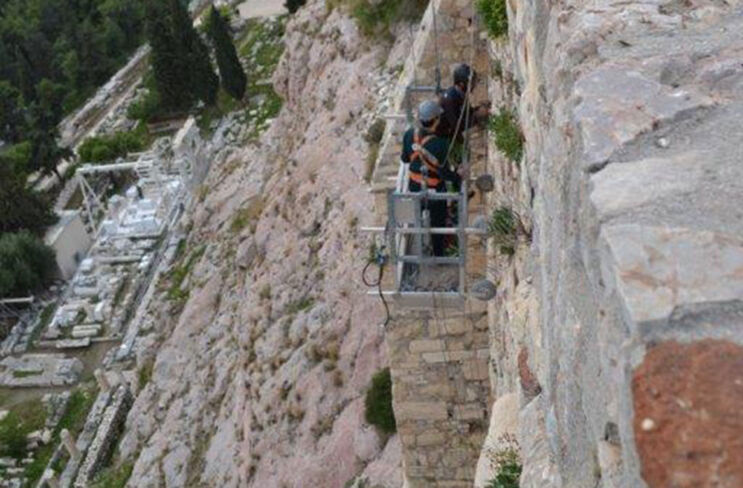
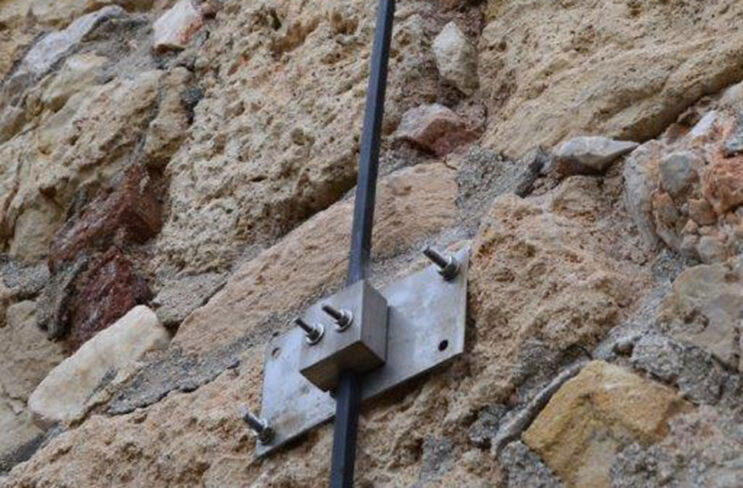
To investigate the behavior of the Acropolis walls, the Acropolis Restoration Service, an authority under the Greek Ministry of Culture, initiated an instrument-based monitoring project and had a network of so-called “fiber Bragg gratings” installed on the walls of the north, east, and south walls. These are optical filters that allow certain light wave ranges to pass through while reflecting others. The highly sensitive sensors of the network continuously supply a control center with information about the degree of deformation of the walls and the condition of particularly endangered zones. In this way, structural assessments can be made and limit values established.
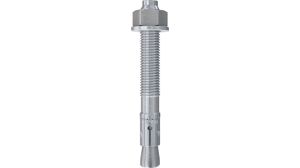
The distinguishing features of the FBN II are the expansion clip and the cone bolt. The anchor is characterized by easy handling and quick installation: drill a hole, drive in the bolt with a few hammer blows, and tighten. When tightening the hex nut, the cone bolt is pulled into the expansion clip and clamps it against the drill hole wall. The bolt geometry allows for optimal load distribution, enabling the anchors to be safely installed even near edges.
In addition to the standard version, there is a short version FBN IIK with a short anchoring depth. The FBN II has the European Technical Assessment (ETA) for non-cracked concrete (Option 7).